RESULTS
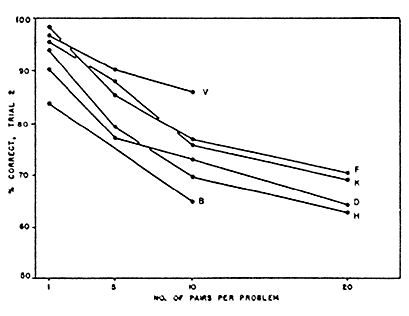
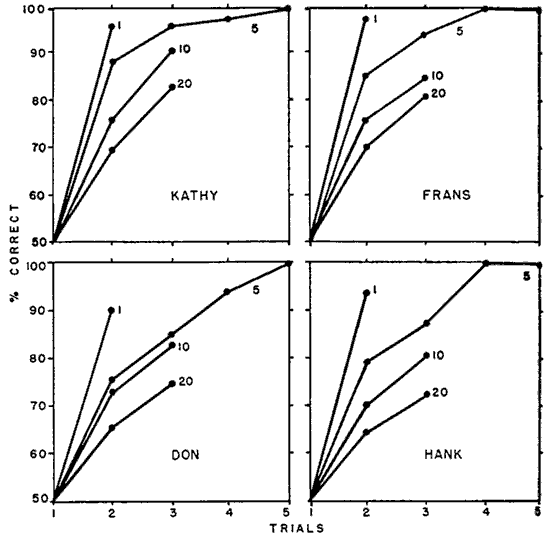
Figure 1 shows how problems consisting of 1, 5, 10, and 20 pairs of objects were solved by four Ss toward the end of their training. (The data for single-pair problems are from an earlier investigation [1].) The relative difficulty of problems containing various numbers of pairs is shown in Figure 2, in terms of second-trial accuracy.
FIG. 1. Concurrent discrimination learning curves for the last 50 single-pair problems, the last 10 five-pair aid ten-pair problems, and the last 5 twenty-pair problems
Our data do not provide a clear picture of the development of a learning set for this kind of work-largely, no doubt, because our procedure was not designed for that purpose. There was some indication of improvement during early training on 5-pair problems, but much less during later 10-pair problems, and none during the 20-pair work. The superior performance of the home-raised chimpanzee, Viki, may be due to a pre-experimental learning set.
FIG. 2. Second-trial accuracy as a function of problem size. Individual subjects are indicated by their initials. Their ages, in years, were: Viki 4 1/2, Frans 6,
Kathy 2 1/2, Don 17, Hank 7, Bokar 26.